A logo file and a two-page voice guide can't teach AI how your firm thinks. Here's what actually belongs in a financial advisor's Brand Foundation Library, part by part.
A logo file, color palette and two-page voice guide are not enough to teach AI how an advisory firm thinks.
They can help content look consistent. They cannot make it accurate, specific or recognizably yours.
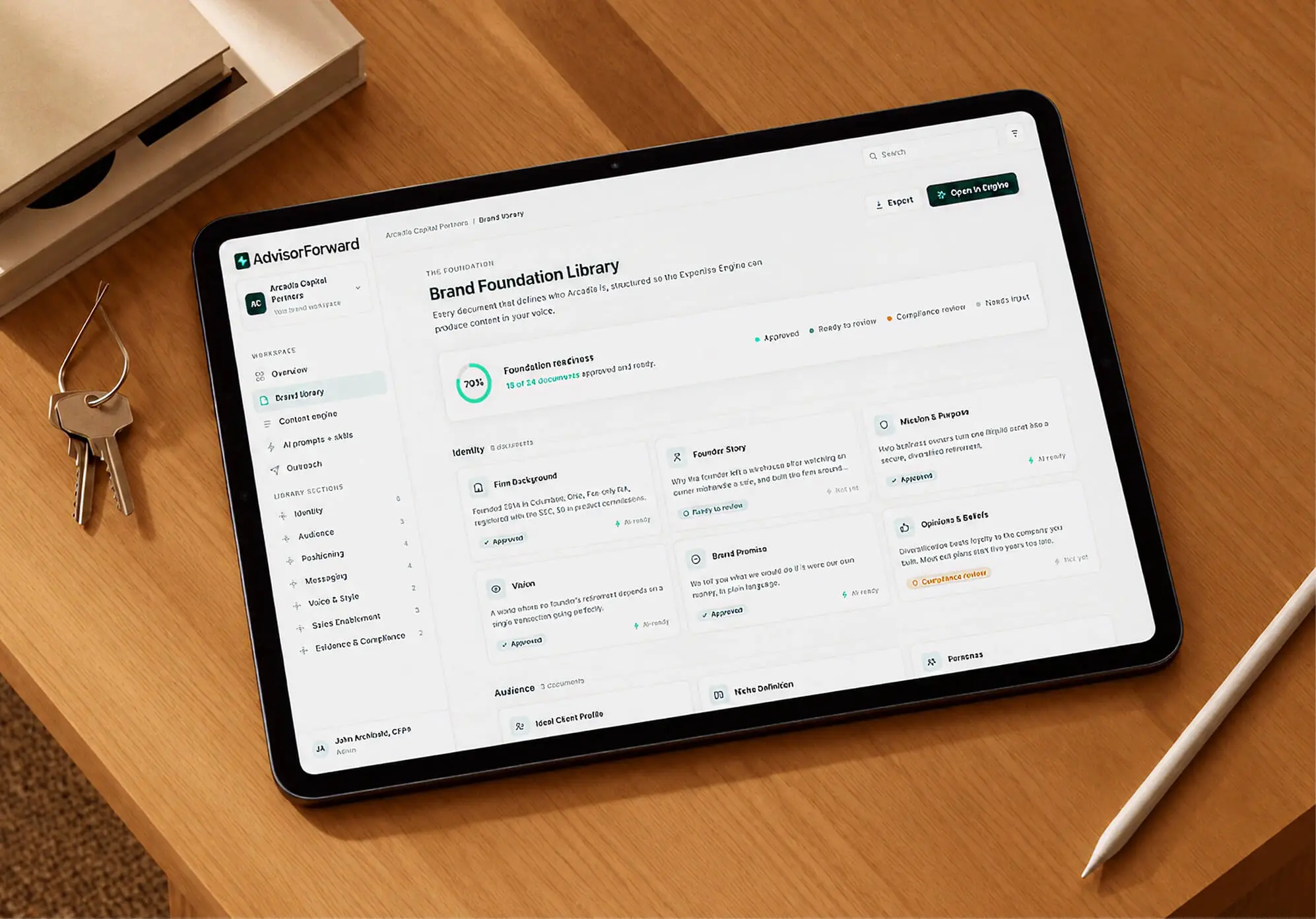
For that, AI needs a structured source of truth about the firm: who it serves, what it believes, how it works, what it can claim and how it communicates. At AdvisorForward, that source is the Brand Foundation Library.
- It is not one large brand document. It is a searchable, versioned library organized into three connected parts:
- The brand library
- The advisor firm knowledge base
The expertise and content context
Together, these documents give advisors, staff, writers and AI tools the same approved foundation.
Part one: the brand library
The brand library defines the firm’s position in the market and the rules for expressing it. It contains 12 core documents.
Positioning and differentiation
This is the canonical statement of who the firm serves, what it helps them do and why the right client should choose it.
It should include a complete positioning statement, a one-sentence version, the value proposition and a ranked set of differentiators supported by evidence.
If the same statement could appear on a competitor’s website, it is not finished.
Niche and specialization
A useful niche is more specific than “high-net-worth families” or “business owners.” It names the recurring, high-stakes problem the firm is equipped to handle.
The document should describe the problem, the events that trigger it and the evidence that the firm already serves these clients well.
For example, “business owners” is a demographic. “Planning the financial decisions surrounding a business sale” is a specialization with identifiable moments, questions and stakes.
Ideal client profile and personas
This document describes the person inside the niche.
It covers their life stage, profession, financial situation, priorities, fears, information sources and decision criteria. It should preserve language taken from real client interviews rather than relying on assumptions.
It also defines who the firm is not for. That boundary helps content attract suitable prospects without trying to appeal to everyone.
Audience pain points and aspirations
This is the record of what clients are trying to solve, expressed in language they would actually use.
It should include practical concerns, emotional stakes, desired outcomes and the questions clients ask before seeking help. Those details give content a recognizable human situation instead of a generic topic.
“Retirement planning can be complex” says very little.
“I can afford to retire, but I do not know which accounts to draw from first or how much I can spend without creating a tax problem later” gives a writer something useful to work with.
Buying triggers and decision journey
People rarely wake up wanting a new financial advisor without a reason.
A job change, business sale, inheritance, approaching retirement, death in the family or dissatisfaction with an existing relationship may turn a long-term concern into an active search.
The library should document those trigger events, what the prospect does next, which questions appear at each stage and what prevents them from acting. Content can then meet the prospect at a real decision point.
Brand narrative and messaging pillars
The narrative explains why the advisor does this work, why the firm exists and what changes for the client.
Supporting messaging pillars identify the small set of ideas the firm should return to throughout its website, articles, emails and conversations.
These pillars give the content calendar a spine. Without them, publishing tends to become a loose collection of market updates, tax reminders and financial tips.
Program and service messaging
Every service should have approved language that explains who it is for, what problem it addresses, what is included and what the client should expect.
If the firm has a named program or planning process, the library should contain short, medium and full descriptions. It should also document the first 90 days, scope boundaries, fee presentation and the verbal explanation the advisor would use in a room.
This keeps the website, proposals and advisor conversations aligned.
FAQs, objections and calls to action
The questions prospects ask repeatedly belong in the library, along with the firm’s approved answers.
That includes practical questions about fees, custody, investment management, communication, planning scope and switching advisors. It should also address common objections and define calls to action appropriate for different stages of the buying process.
An AI tool should not invent an answer to a question the firm has already settled.
Brand voice and tone
The voice guide defines how the firm sounds across website copy, educational articles, personal correspondence and sensitive client situations.
Useful voice attributes include examples and counterexamples. “Professional, trustworthy and approachable” is too broad. Almost every advisory firm would claim the same traits.
- A stronger guide might say:
- Explain the decision before describing the service.
- State tradeoffs directly.
- Avoid manufacturing urgency.
- Use the language clients use in meetings.
- Reduce technical detail when it does not change the decision.
Never use a market decline as a reason to promote the firm.
The document should include side-by-side samples of writing that sounds like the advisor and writing that does not.
Approved and banned language
The approved language bank contains phrases the firm can reuse with confidence: its niche, program, methodology, process and strongest explanations.
The banned list captures language that is generic, off-voice or inconsistent with the firm’s compliance requirements. It should also offer replacements.
Banning “personalized financial solutions” is useful. Documenting the specific sentence the firm uses instead is better.
Visual identity and design rules
AI-generated presentations, graphics and documents need design context too.
This part of the library holds logos, color values, typography, photography direction, layout rules, chart styling and examples of correct and incorrect use. It should be detailed enough for a staff member or production tool to create a new asset without guessing.
Compliance and messaging guardrails
The library should document what the firm’s marketing may and may not say.
This includes required disclosures, citation standards, rules for testimonials and client stories, treatment of performance claims, topics requiring additional review and the path content follows before publication.
These rules come from the firm’s compliance officer and existing policies. They do not replace compliance review. They make routine content easier to prepare and identify what requires escalation.
Part two: the advisor firm knowledge base
The brand documents explain how the firm should present itself. The knowledge base holds the facts that must remain accurate.
- It should cover:
- Firm name, locations, registration status and other company facts
- Advisor and team profiles
- Firm history and brand story
- Named programs and service offerings
- The firm’s planning methodology
- Investment and planning philosophy
- Client experience and service model
- Credentials, expertise and specializations
- Approved proof, testimonials and supporting evidence
- Frequently asked questions
Standard terminology, disclosures and the firm glossary
These documents prevent small but damaging errors. An AI assistant should not guess at a credential, meeting cadence, service boundary or regulatory fact.
The knowledge base should state facts plainly. If information is unavailable, the instructions should tell the AI to flag the gap rather than fill it.
Part three: expertise and content context
This is where the advisor’s thinking becomes usable.
- The expertise and content context should include:
- An organized library of the advisor’s subject-matter expertise
- Thought leadership topics
- Content pillars
- Defensible beliefs and points of view
- Named frameworks, processes and other ownable intellectual property
- Approved content examples and patterns
A source and citation library
This material often comes from interviews, client conversations, process walkthroughs and reviews of past writing.
It captures the explanations the advisor gives in meetings, the mistakes they see repeatedly and the opinions they have formed through experience. That is the material generic AI output is missing.
A model can summarize retirement planning from general knowledge. It cannot know how a particular advisor explains the tension between tax efficiency, spending flexibility and estate goals unless that thinking has been documented.
What makes the library usable
Completeness alone is not enough. A disorganized collection of documents creates its own problems.
Each file should cover one clear subject. It should have a purpose, version and date. Facts should be unambiguous. Rules should be written as direct instructions. Examples should show what to do and what to avoid.
The library also needs precedence rules. Compliance guardrails should override voice preferences. The voice guide should override an isolated writing example. The current approved version should override every older copy.
For use with AI, the files should be available in clean text or Markdown. Decorative layouts, long tables and scanned PDFs make the material harder to retrieve and apply.
Start with the documents that change the output
- A complete library takes time to build. An advisor testing AI can begin with a smaller set:
- Positioning and differentiation
- Ideal client profile
- Services and methodology
- Firm facts
- Voice and tone
- Approved and banned language
- Compliance guardrails
Several examples of approved writing
That is enough to improve the quality of an early workflow.
It is not the finished system. The remaining documents add the depth needed to support a website, ongoing content, staff training and more complex AI-assisted work.
Keep the foundation current
A Brand Foundation Library is not an archive.
Services change. The firm hires new people. Prospect questions reveal gaps. Compliance decisions create new approved language. Published content shows which explanations land and which ones need work.
Those changes should flow back into the library. Each update needs a clear owner, an approval path and version history. Prompts, skills and agents should always work from the current approved documents.
Without that upkeep, the firm slowly returns to the same problem the library was built to solve: different people and tools presenting different versions of the business.
The practical test
- Give the library to a writer or staff member who has never worked with the firm. Ask them to explain:
- Who the firm serves
- Why those clients seek help
- How the firm approaches the work
- What makes its position different
- Which language it uses and avoids
- What claims require care
What the advisor believes about the topic
Then ask an AI tool to draft a prospect email or article using only the relevant library files.
If the result is accurate, specific and close to the advisor’s natural voice, the foundation is doing its job.
If the advisor has to correct facts, restate the audience and rewrite every paragraph, the problem may not be the AI. The source material is incomplete.
CTA: See how AdvisorForward builds your Brand Foundation Library.